The input looks simpler: find two or more of a colour touching, tap them, they go. The consequence is that you can never reorganise the board, only consume it, and that is a fundamentally different problem.
You spend the board, you never rearrange it
This is the whole thing, and everything else in this guide follows from it. In a swap game, moving two tiles changes their positions without removing anything, so a board that looks bad can be reorganised into a board that looks good. In a tap game there is no swap. The only action available removes tiles, so every move makes the board strictly smaller.
That means a tap board cannot be repaired. If you spend the colour you needed, it is gone, and the only replacement comes from the refill at the top. There is no clever sequence that rebuilds what you used, which is why these games punish carelessness in the first ten moves far more than swap games do.
Group size is a spectrum, not a threshold
Swap games have a hard rule: three or more. Tap games usually accept two, which sounds generous and is actually the trap. A two-tap is legal, instant and almost always a mistake, because it consumes two tiles of a colour and returns nothing except a small gap.
Special tiles in these games are produced by group size, typically at five, seven and nine or thereabouts depending on the title. So every two-tap you take is material subtracted from a group that could have crossed one of those thresholds. The discipline is to leave small groups alone and let the board grow them.
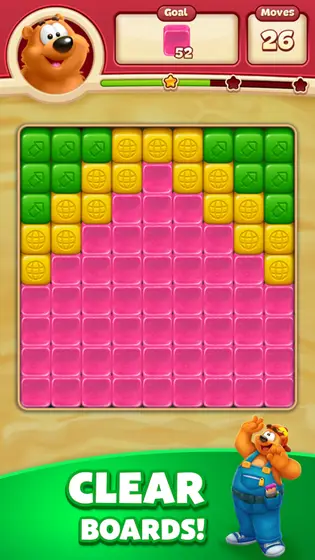
The single habit that improves results most in tap games: before each tap, check whether the group would be bigger in two moves' time if you cleared something beneath it instead. It usually would.
Gravity does the work you would otherwise do by hand
Because you cannot swap, the only way to bring two separated clusters of the same colour together is to remove what is between or below them and let them fall into contact. Gravity is your rearrangement tool, and it works in exactly one direction.
This gives a clean planning rule that has no equivalent in swap games: to merge two clusters, clear directly under the higher one. To keep clusters apart, which occasionally matters when a level counts separate clears, avoid touching anything beneath them.
Why these boards feel easy and end badly
The first two thirds of a tap level are comfortable. There are plenty of tiles, plenty of legal moves, and progress feels rapid. Then the board thins, the remaining tiles are scattered singles of five different colours, and nothing connects to anything.
That end state is not bad luck. It is the accumulated result of every two-tap taken earlier, each of which removed a little colour density from the board. Players who finish these levels comfortably are not luckier at the end; they were stingier at the beginning.
Reading a tap board before the first move
- Count colours. Five colours on a small board is tight, three is comfortable. More colours means less density, which means fewer large groups.
- Find the largest existing group. That is your special, and it should be grown, not spent.
- Look underneath it. Whatever sits below the largest group is what you clear first, because doing so drops more of that colour into it.
- Note the goal position. If the goal is at the bottom, clearing above it wastes moves; if it is at the top, clearing below brings it down.
Where these games converge with swap games again
Obstacles behave identically in both families: spreading ones are urgent, blockers interrupt columns, layered ones can be counted and budgeted. So a player coming from swap games already knows how to read the obstacle layer and only needs to relearn the movement layer.
The boosters are the other point of convergence, and they are worth their own treatment, which is in the guide on combining boosters. The short version is that the combination rules are more generous here than in swap games, and correspondingly more worth planning around.