The hardest thing to see on a tap board is not the obstacle layer, it is the colour count. It is never stated anywhere, it decides whether large groups can form at all, and it is visible in about two seconds once you know to look.
Density, not size
A board with sixty tiles in three colours holds an average of twenty per colour, which clusters readily and produces large groups without any help. The same sixty tiles in six colours average ten each, scattered across the whole board, and large groups become rare events rather than a normal consequence of play.
This is why two levels with identical layouts, identical goals and identical move counts can feel entirely different. The colour count is the difficulty dial, and it is the one number the game never displays.
Counting colours before you start
It takes a couple of seconds and changes the plan. Look across the board and count distinct colours, then decide which of two modes you are in.
- Three or four colours. Groups form naturally. You can afford to be patient, wait for large groups and expect boosters to arrive without engineering them.
- Five or more. Large groups will not form on their own. You need to build them by clearing beneath clusters to merge them, and boosters must be planned rather than expected.

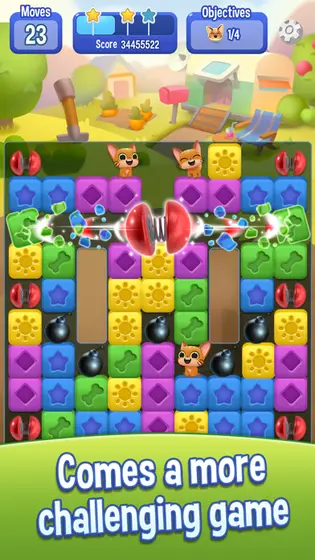

The scarce colour rule
When a level asks for a specific colour and that colour is thin on the board, everything else becomes secondary. Each tile of it that you spend in a small tap is a tile the counter will not get, and the refill may not replace it in the proportion you need.
The discipline is uncomfortable but simple: do not touch the scarce colour except when the tap serves the goal. Clear the plentiful colours to move the board and let the scarce one accumulate. Players who lose these levels almost always spent the scarce colour early, in small taps, while it was still plentiful enough to feel expendable.
If two colours are both goals and both scarce, prioritise whichever has fewer tiles visible. The other will still be there in three moves; the scarcer one may not.
Escort levels and the cost of a clear column
Levels that ask you to bring an object down to the bottom add a second constraint on top of colour scarcity. The object descends only when the tiles beneath it go, so you need a specific column cleared, which competes directly with clearing wherever the colours happen to be convenient.
The way through is to accept the inefficiency early. Spend the opening moves on the column, even though those moves clear less than moves elsewhere would, because the alternative is arriving at move fifteen with the object still at the top and nothing left to move it with.
Watching what the refill gives you
The refill draws from the same colour set as the board, so a level with six colours keeps returning six colours and never becomes denser on its own. This is the part people hope will save them and it does not. If the board is thin at move ten, it will still be thin at move twenty, with fewer tiles.
Recognising a level as structurally thin early is genuinely useful, because it changes the decision from playing on hopefully to either committing a booster or restarting deliberately. Both are better than the third option, which is discovering the problem with two moves left.
Why this matters more here than in swap games
A swap board with six colours is still workable, because swapping lets you assemble a match from tiles that are near each other but not adjacent. A tap board offers no such tool: tiles must already be touching, or must be brought together by clearing underneath. Scarcity therefore bites harder in this family of games than in any other, and it is the single most useful thing to check before spending the first move.